







Newsletter Subscribe
Join thousands of readers who get our Sunday Briefing: one email, five essential stories, zero fluff. Subscribe NOW!


Small businesses are being pressured into expensive, unnecessary web development projects. Here is why the headless WordPress trend is often a trap.
Talking Points: The rise of over-engineered tech, how marketing departments sell vanity projects, and why expensive isn’t better.
I sat in a meeting last year watching an agency pitch a local bakery on a six-figure “modern” web build. They kept throwing around technical jargon about decoupled architecture and frontend frameworks like they were passing out candy. The bakery owner just wanted an online menu and a way to take credit card orders without the site crashing on a busy Sunday. They were being sold a Ferrari to drive to the mailbox. This industry loves to wrap basic business needs in shiny, expensive packaging to pad their own pockets.
Talking Points: Monolithic vs microservices architecture, how WordPress works under the hood, and the API-driven development shift.
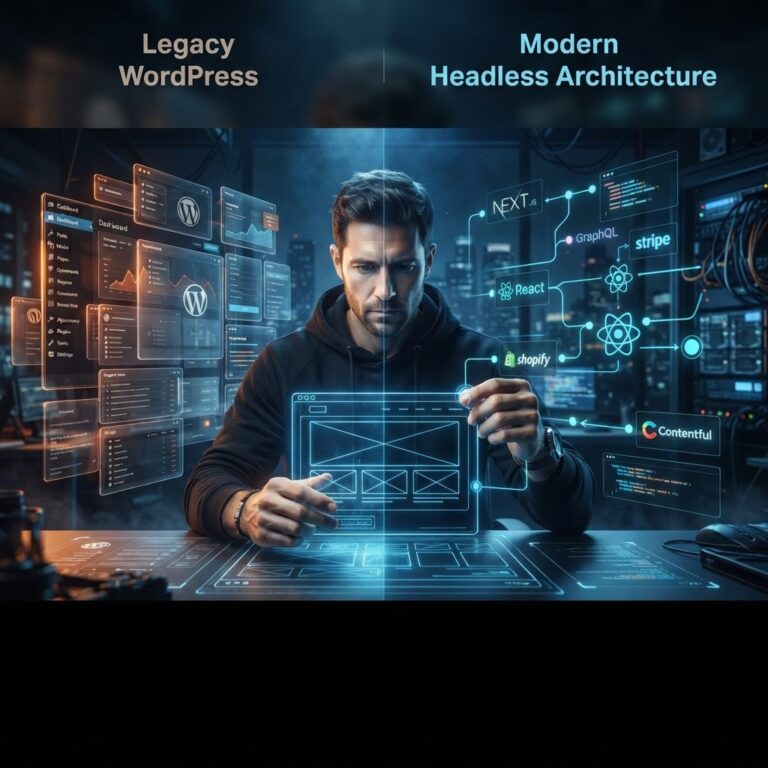
Traditional WordPress is the standard. You get your content, your design, and your management tools all in one bundle. It works because it is a monolithic system. Every piece is connected and talking to the others seamlessly. When you click a button, the server does the work and sends the page to your browser. Simple. Effective.
Headless CMS vs traditional CMS is the battleground of modern web dev. In a headless setup, you rip the brain out of WordPress and use it only to store data. You then build a completely separate front end using complex code. You need an API-driven development process just to show a customer a photo of a croissant. If your site doesn’t have thousands of pages or massive data needs, this is overkill.
Talking Points: Static site generation, server-side rendering realities, and why speed is rarely the actual problem.
Developers will swear that headless WordPress architecture for small business is the only way to get sub-second load times. They talk up static site generation as if it is magic. I have seen standard, well-optimized WordPress sites load faster than most of these over-engineered headless monsters. Most small businesses don’t need a CDN-distributed, static-rendered architecture to sell coffee beans. They need a host that isn’t running on a ten-year-old server. Fix the image sizes before you touch the architecture.
Talking Points: Developer talent acquisition, resume building, and the lack of plugin ecosystem compatibility.
Let’s be honest. Your developer probably wants to build a headless site because they want a cool project for their portfolio. They want to get paid to learn React or Vue on your dime. It makes them feel like a “senior engineer” rather than a web designer. That is fine, but it is not good for your bottom line. They rarely tell you that headless kills the plugin ecosystem compatibility you rely on. You lose the simple tools that make WordPress actually useful for small business owners.
Talking Points: Maintenance overhead, technical debt in web development, and the reliance on custom code.
Traditional sites are easy to fix. If a plugin breaks, you update it or swap it for another. With headless, you have created a stack of cards. One update to your frontend framework or a change in your API call, and the whole thing goes dark. You are now tied to a specific developer or agency who understands the custom mess they built for you. That is technical debt in web development at its finest. You lose control of your own business tools.
Talking Points: User experience optimization, budget-friendly growth, and ease of management.
Most sites belong on a standard, well-maintained WordPress install. It is the best way to keep website development costs small business friendly. You can drag and drop, manage your own media, and install a plugin to handle basic SEO. You are in the driver’s seat. Why would you pay a monthly retainer to an agency just to change a sentence in your “About Us” section? Keep it simple.
Talking Points: Scaling complexity, large content repositories, and complex frontend requirements.
I don’t hate headless tech. I hate when it’s sold to people who don’t need it. If you are a massive media company with fifty editors and a custom app that needs to pull data into three different mobile interfaces simultaneously, then headless is the correct move. That is when scaling complexity actually justifies the price tag. If you are a plumbing service or a local shop, you are just throwing money away.
Talking Points: Licensing, hosting fees, developer hourly rates, and long-term viability.
Look at the total cost of ownership beyond just the initial build. A traditional site is cheap to host and easy to maintain. A headless build has a massive hidden bill. You are paying for a separate hosting environment for your frontend, a developer to maintain the API, and custom fixes every time a security update rolls out. The math almost never works in favor of the small business.
Talking Points: Ignoring tech stack vanity, focusing on revenue-generating activities, and aligning tools with expertise.
Stop asking what the “new” way to build a site is. Start asking what will help you sell more products. Tech stack vanity is the silent killer of small business profits. If your site works, brings in leads, and is easy to update, then your architecture is perfect. Do not let someone talk you into a complex rebuild just because they want to chase a trend.
Talking Points: Why simplicity wins, controlling your own assets, and making smart investments.
We build websites to make money, not to win awards for code purity. Keep your setup standard. If you are currently feeling pressured to move to headless, ask yourself why. Is it really for the users, or is it for the developer’s resume? Build for profit and leave the vanity projects to the startups with venture capital money. Let’s talk about your actual needs in the comments below.
Absolutely. Most sites are slow because of bloated themes, oversized images, and bad hosting providers. Start by cleaning up your media and moving to a better host; you will likely see a massive performance gain without touching the architecture.
Not inherently. Search engines care about content quality, site structure, and load speed. You can achieve all of these in a standard WordPress setup with much less effort and cost than a headless configuration.
Vendor lock-in is the biggest risk. Because the build is custom and complex, you become completely dependent on the agency or developer who built it. If they leave, you are left with a system that is incredibly hard to find someone else to fix.
Some, but most standard plugins that rely on frontend rendering will stop working. You end up having to build your own solutions for things like contact forms, image galleries, and SEO metadata, which adds thousands to your development costs.
If you have a massive, multi-channel digital operation where content must be pushed to web, mobile apps, and smart devices simultaneously, you might need it. If you just have a standard business website, you do not need headless.