


Newsletter Subscribe
Join thousands of readers who get our Sunday Briefing: one email, five essential stories, zero fluff. Subscribe NOW!

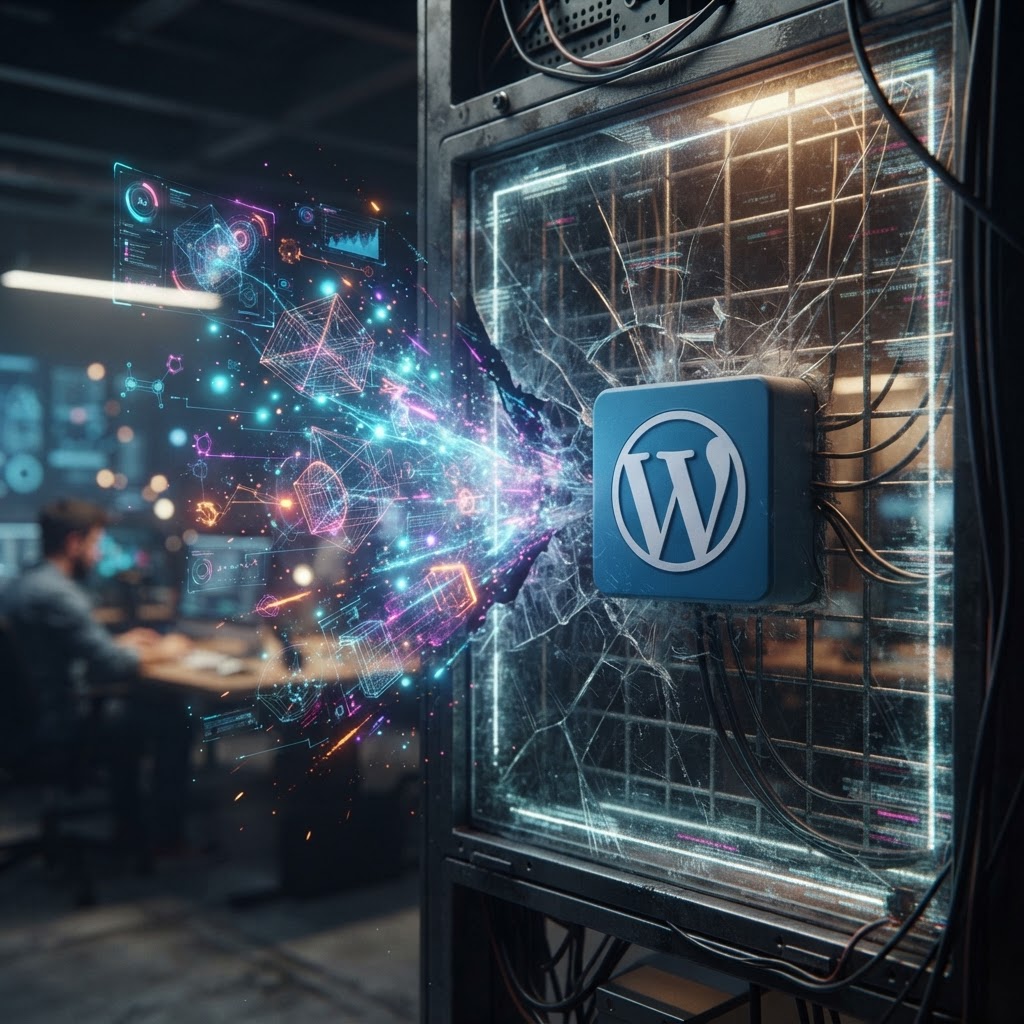
WordPress isn't ready for the weight of volumetric media. Stop chasing metaverse hype and start focusing on the performance bottlenecks that actually kill your site conversions.
Talking Points:
* The persistent myth of metaverse readiness.
* Why WordPress architecture hates your 3D dreams.
* Setting expectations for web-based AR integration.
I sat at my desk last month watching a client try to load a five-hundred-megabyte GLB file onto a shared hosting account. It crashed. Obviously.
The industry keeps screaming about metaverse readiness, yet we act like WordPress is some magical container for infinite data. It is not. WordPress volumetric media support is currently a pipe dream masquerading as a feature list.
We love shiny objects. We see a cool AR content in WordPress demo and think, “I need that on my homepage.” Stop. You are trying to fit a skyscraper into a garden shed.
Talking Points:
* The massive difference between 3D files and true volumetric data.
* Why six degrees of freedom matters.
* The confusion surrounding mesh-based animation.
People confuse static models with volumetric data constantly. A simple rotating shoe is a static model. A volumetric capture of a person walking? That is a data monster.
True volumetric media requires six degrees of freedom. You move left, right, up, down, forward, and backward. If your viewer cannot move in space, it is just fancy 3D rendering.
Most folks see a 360-degree video and call it immersive. It is not. It is just rotational. You are being lied to by marketing brochures that want your budget.
Talking Points:
* WordPress was never built for heavy spatial data.
* Server-side limitations and PHP execution time.
* The struggle with database bloat and media handling.
WordPress core was built for text. Maybe a few images. It struggles with heavy spatial data because it treats everything like a post.
When you try to upload point cloud rendering data through the media library, the server chokes. Your PHP execution time limit is your first enemy. Then comes the database itself.
Trying to manage massive assets inside a CMS designed for blogging is like driving a bicycle in a NASCAR race. You will break something.
Talking Points:
* Third-party plugins are temporary bandages.
* Dependency on external libraries for GLB/glTF optimization.
* The fragility of the WordPress plugin ecosystem.
Plugins promise to bridge the gap. They rarely deliver performance. Most just load a library like Three.js and hope for the best.
These patches break when WordPress updates. I have seen sites go dark because an AR viewer plugin failed during a core upgrade. It is a nightmare.
Never rely on a free plugin to handle your high-fidelity 3D assets. You are one bad update away from total site failure.
Talking Points:
* Mobile performance stats and the one-second rule.
* How bandwidth management for 3D kills your SEO.
* The reality of visitor abandonment rates.
Only about 44% of mobile sites pass Core Web Vitals. Add a heavy volumetric asset and you will join the failing 56%. It is that simple.
If your page takes an extra second to load, you lose 20% of your visitors. That is cold, hard cash walking out the door.
Immersive media is a vanity project if it kills your conversion rate. Your visitors do not care about your holographic display if they never get to see it.
Talking Points:
* WebXR API compatibility struggles.
* Browser-based spatial computing limitations.
* The challenge of cross-browser consistency.
WebXR is getting better. But it is not ready for prime time on mobile browsers. It is buggy and slow.
You run into issues with HTTP connection limits. Browsers are not built to stream multi-gigabyte spatial data while also running your site scripts. WebGL browser performance fluctuates wildly between Chrome and Safari.
If it works on your desktop but hangs on your phone, you have failed the user. That is the reality of the modern web.
Talking Points:
* Don’t host spatial assets on your server.
* Use CDN media offloading effectively.
* Keeping your server lightweight for core functions.
If you are dead-set on embedding volumetric video, do not host it on your server. Move it to a specialized CDN or a dedicated storage bucket.
Your WordPress server should only hold the reference link. Let the cloud handle the bandwidth management for 3D assets. This is the only way to survive.
Keep your server lean. If your server is working hard to serve a 3D model, your text content will crawl. Protect your site speed at all costs.
Talking Points:
* The myth of easy, high-quality AR plugins.
* Why custom coding remains the only reliable route.
* Managing real-time 3D rendering expectations.
Clients ask for drag-and-drop AR all the time. I tell them no. It is an unprofessional fantasy that usually ends in a broken mess.
You need a developer who knows how to optimize spatial data compression. You need someone who can handle the math behind the rendering. Drag-and-drop will never offer that level of polish.
If you want immersive, pay for a real developer. Otherwise, stick to static images.
Talking Points:
* When immersive media drives users away.
* Analyzing high bounce rates on 3D-heavy landing pages.
* The danger of over-engineering the UX.
I once worked on a site that featured a spinning 3D product model right at the fold. Bounce rates hit 80%. Why? Because people just wanted to read the specs.
They did not care about the hologram. They wanted the price. When you force interaction, you annoy the user.
Design for the user’s needs, not your own desire for fancy tech. If the immersive element does not add value, kill it.
We need to stop chasing the hype. Your site is not a gaming console. It is a tool for information, communication, and business.
Technical sobriety means choosing performance over flashy gimmicks. If you want to use immersive media, understand the cost. Measure the impact on your load times.
Look at your analytics. Are your users actually engaging with your 3D assets, or are they waiting for your site to load? Share your experiences with volumetric experiments in the comments below. Let us stop pretending these broken tools are ready for real-world usage.
1. Question: Can I host volumetric files in my WordPress media library?
Answer: You technically can, but it is a terrible idea that will bloat your database and slow your site to a crawl.
2. Question: Are there any plugins that offer true volumetric support?
Answer: No plugin provides native support, and most rely on external libraries that can break your site’s performance.
3. Question: Does immersive media actually hurt my SEO?
Answer: Yes, by dragging down your Core Web Vitals, it negatively impacts your ranking and your conversion rates.
4. Question: What is the best way to display a 3D model on a WordPress site?
Answer: Offload the file to a CDN and use a lightweight, custom-coded viewer to embed the asset without stressing your server.
5. Question: Why is six degrees of freedom so hard to implement on the web?
Answer: It requires intense browser-based spatial computing that most mobile devices cannot handle smoothly without serious lag.