






Newsletter Subscribe
Join thousands of readers who get our Sunday Briefing: one email, five essential stories, zero fluff. Subscribe NOW!


Stop playing manual admin. Discover how configuring AI agents via the Model Context Protocol (MCP) can transform your WordPress workflow into an autonomous, efficient machine.
Talking Points: WordPress dominance stats, the inefficiency of manual dashboard management, the shift toward autonomous site administration.
WordPress runs over 40% of the web. That is a massive statistic. Yet, most of us still treat it like a chore. We click buttons. We wait for page loads. We manually update plugins. It is tedious. It is archaic.
I spent years clicking “Update” until my eyes glazed over. It felt like productivity, but it was just busywork. My site needed help, not a babysitter. Configuring AI agents (MCP) to manage WP content finally changed that.
Talking Points: Why manual workflows create bottlenecks, the limitations of standard dashboard interfaces, the hidden costs of human latency.
We love to think we are in control. Every post published, every plugin tweaked by hand feels like craft. Reality? It is just a bottleneck. Human speed is the slowest part of any content pipeline optimization strategy.
I remember an SEO audit that took me four days of clicking back and forth. A machine could have done it in minutes. Why keep working that way? Stubbornness, mostly. We equate “being busy” with “being effective.” It is a lie.
Talking Points: Explaining the Model Context Protocol, how it differs from traditional plugins, the shift from static to dynamic interaction.
People hear Model Context Protocol WordPress and panic. They think it is another bloated plugin. Wrong. It is a protocol. Think of it as a shared language for machines.
It allows AI agents to talk to your site directly. No middleware, no messy scrapers. Just pure data flow between your brain and your server. It is clean. It is fast.
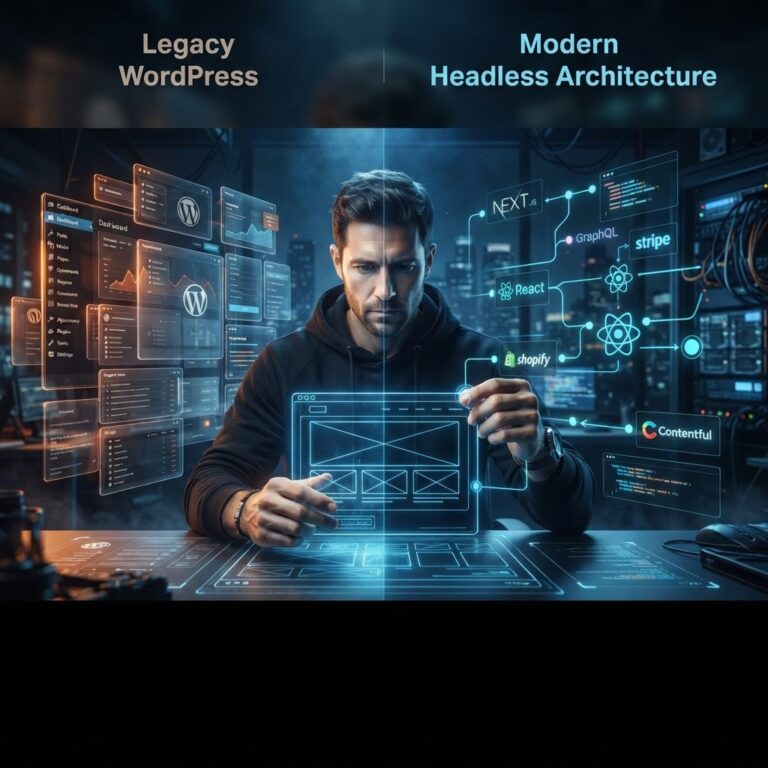
Talking Points: How the WordPress MCP adapter functions, connecting AI agents to site primitives, the transition to headless WordPress automation.
Installing the WordPress MCP adapter feels like giving your site a nervous system. It exposes your site functions as executable tools. You are no longer guessing what the AI can do.
You can query your own data using the Abilities API. The agent sees your content. It sees your structure. It knows what it can touch and what it cannot.
Talking Points: Distinguishing between passive AI writers and active AI administrators, the benefits of agent-led site management, shifting the focus from generation to execution.
Most people use AI to write fluff. Don’t do that. That is wasting potential. Use AI to run the site itself.
When you stop using AI for just writing, you start using it for WordPress AI workflow integration. It can check broken links. It can resize images. It can manage maintenance modes. It becomes your employee, not your pen.
Talking Points: Step-by-step setup, server-side requirements, the role of WordPress REST API.
You need to prepare your environment. This isn’t for the faint of heart. Start by verifying your PHP runtime diagnostics. Ensure your REST API is stable.
Then, map your tools. Configure your MCP server architecture to talk to your specific database. It takes an hour. It saves you months.
Talking Points: Dangers of over-privileged access, using application passwords for secure AI site access, protecting sensitive site data.
Security is not optional. You might be tempted to use your main admin login. Stop. That is reckless. Use application passwords.
These provide fine-grained, secure AI site access. If an agent goes rogue, you kill the key. Your site stays locked. It is basic digital hygiene.
Talking Points: Practical use cases for AI agents, bulk metadata management, automated SEO auditing workflows.
Imagine an agent running an automated SEO auditing script every Sunday night. It finds missed alt tags. It suggests internal link updates. You just approve the changes.
That is power. It is not just about moving fast. It is about being consistent. You cannot forget to audit if the agent never sleeps.
Talking Points: The necessity of human oversight, risks of unchecked AI decisions, human as the final gatekeeper.
I trust machines for math. I do not trust them for brand voice. You must remain the final gatekeeper for critical changes. One wrong command could break your permalinks.
Automation is a tool, not a replacement for judgment. Use it to do the work. Use your eyes to check the quality.
Talking Points: Identifying errors in agent execution, how to troubleshoot AI-triggered WP errors, avoiding recursive loops.
Agents fail. They get confused. Sometimes they try to delete things they should not. Watch your logs. Test in a staging environment first.
If you see weird behavior, pull the plug. Debugging MCP setups is easier than fixing a corrupted database. Learn the signs of a loop before it happens.
Talking Points: Why the traditional dashboard is becoming a legacy interface, the shift toward agent-first CMS management, evolving site interaction patterns.
The admin dashboard is dying. It is a clunky relic of the 2000s. We are moving toward direct agentic command.
We will talk to our sites. We will command them. The era of clicking through ten menus to change a setting is almost over. Embrace it now, or get left behind.
Automation is not for everyone. It is for people who want results. If you are tired of playing admin, start building your agents. It is the only way to scale without burning out.
Try setting up a small task first. Maybe just a meta-description sync. Watch it work. See how it changes your pace. Let me know what you think in the comments. I want to hear your horror stories and your wins.
1. Question: Is the WordPress MCP adapter a plugin I can just install and forget?
Answer: No, it is a protocol-based bridge that requires active configuration. It is not a set-it-and-forget-it plugin but a tool for creating dynamic workflows.
2. Question: Can AI agents replace human content editors entirely?
Answer: Definitely not. Humans are the final gatekeepers. Agents are for the grunt work like bulk metadata, while you handle the quality and intent.
3. Question: What security risks are involved when connecting AI to WordPress?
Answer: The main risk is over-privilege. Always use application passwords to limit access to only what the agent needs, rather than giving it full administrator credentials.
4. Question: Does this require coding knowledge?
Answer: You need some technical awareness. While the setup is becoming more accessible, understanding basic API interaction and server management helps significantly.
5. Question: How does this help with site performance?
Answer: By automating tasks like image optimization, plugin management, and bulk database updates, agents reduce manual overhead and can improve your site’s operational efficiency.