






Newsletter Subscribe
Join thousands of readers who get our Sunday Briefing: one email, five essential stories, zero fluff. Subscribe NOW!

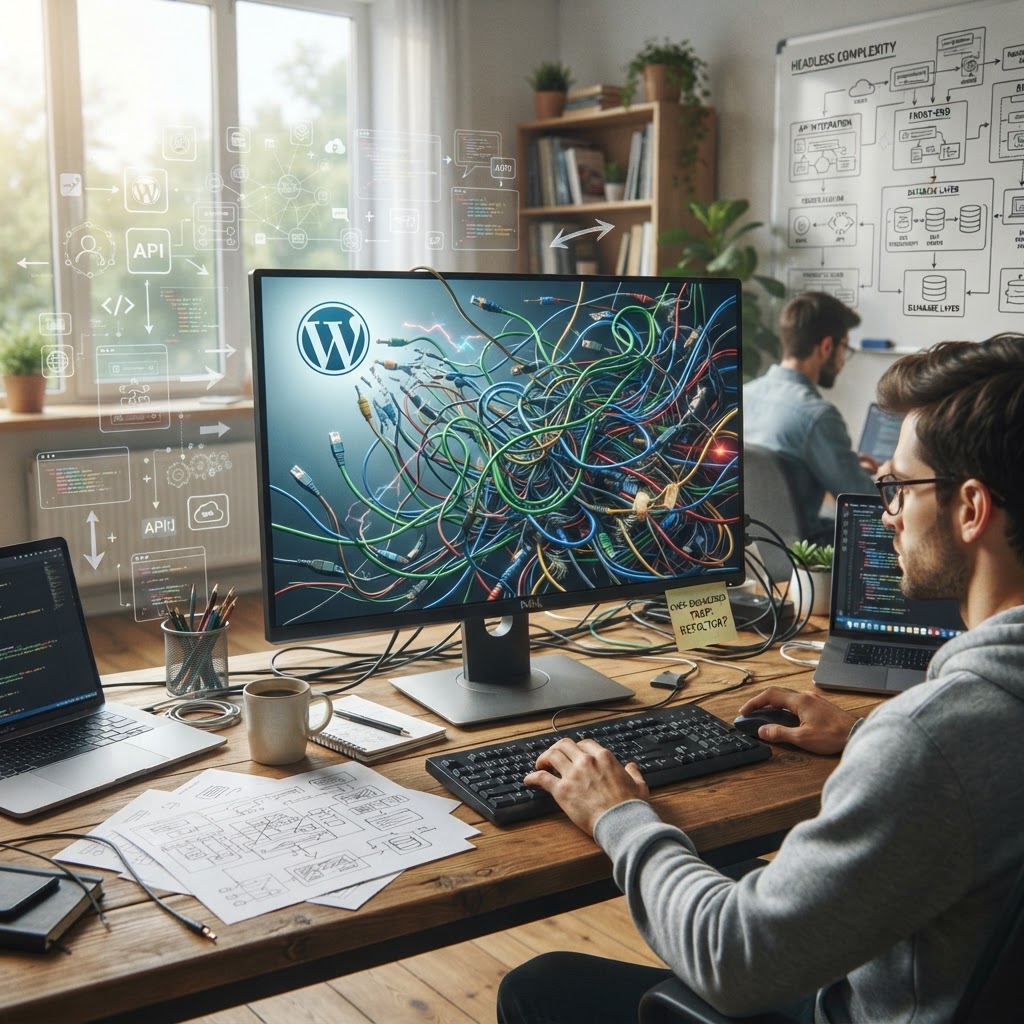
Headless WordPress is often marketed as the future, but for most marketing sites, it is just an unnecessary, costly, and complex trap that hurts your SEO and agility.
Talking Points:
Everyone loves a shiny new object. A few years back, I watched a team of smart developers throw away a perfectly functional, high-converting marketing site just to chase the headless dream. They spent six months and a small fortune replacing a theme-based setup with a complex JavaScript framework for WordPress. The result? A site that took three times longer to update and broke every time a plugin was touched.
We see this trend constantly. The promise of headless WordPress for marketing sites sounds sleek on paper. You detach the backend, plug in a React frontend, and suddenly you are a modern tech powerhouse. Except, you aren’t. You are just a group of people who made simple tasks hard. Marketing sites exist to push content, track leads, and look good. They do not need to be over-engineered puzzles.
Talking Points:
At its core, headless WordPress removes the theme layer entirely. The database still sits there, but the WordPress interface becomes a headless CMS vs traditional WordPress setup where the front and back no longer speak the same language. You send data out through a REST API or GraphQL schema. Then, a separate application pulls that data to display it.
This architectural evolution is great for apps. If you are building a proprietary dashboard or a custom mobile application that needs content pushed to various screens, this is your solution. For a standard marketing site, it is overkill. You are effectively taking a Swiss Army knife and duct-taping it to a specialized carving tool. It works, but why would you bother?
Talking Points:
I have seen marketing managers cry over headless migrations. In a traditional site, they hit ‘Preview’ and see exactly what the page looks like. In a headless setup, that feature often vanishes. They are forced to wait for deployment cycles or bug-ridden preview environments to see a simple text change.
This is the hidden complexity tax. You are creating a wall between the people who create content and the audience that consumes it. Plugins that once saved hours of work now become incompatible. You have effectively handcuffed the people responsible for your ROI. If your marketing team spends more time asking devs for “fixes” than they do writing copy, your tech stack has failed.
Talking Points:
People scream about speed as the primary justification for headless. They point to performance benchmarks showing blazing fast metrics. They forget to mention that a well-optimized, traditional WordPress install with proper caching hits the same marks. Headless WordPress is not inherently faster.
Speed depends on how you build, not just the architecture. If you slap a heavy JavaScript framework on top of a slow server, your site will crawl. Static site generation helps, but it introduces massive friction every time you want to hit ‘Publish’. Many developers chasing these metrics are just trying to fix bad hosting with expensive, unnecessary code. Proper hosting and caching provide 95% of the gains with 1% of the pain.
Talking Points:
SEO is the lifeblood of marketing. In traditional WordPress, plugins like Yoast or RankMath handle the heavy lifting of meta tags, social sharing, and sitemaps. When you go headless, that automation disappears. You are left to build these features from scratch via the API.
If your developer misses one tag or messes up the canonical URL structure during a build, your organic traffic will tank. I have seen companies lose 30% of their search visibility in a week because a headless migration stripped their schema data. Vendors rarely mention this, but you are trading a “set it and forget it” system for a manual labor nightmare.
Talking Points:
Operating a headless site means you are managing two distinct entities. You have the WordPress backend, which still needs updates, and the frontend, which requires its own deployment pipeline and server environment. You have doubled your attack surface and your points of failure.
When something breaks, you now have to debug two different stacks. Did the API stop sending data? Did the frontend crash during build? It is a recipe for massive developer burnout. Your team will spend more time keeping the lights on than building features that actually generate revenue. Keep it simple and keep your team sane.
Talking Points:
Does headless ever make sense? Sure. If you are a giant retailer pushing content to web browsers, iOS apps, Android apps, and digital in-store kiosks simultaneously, you need a decoupled approach. You need a single source of truth for your copy.
But if you are a marketing team running a corporate site, a landing page, or a blog, headless is a vanity project. It serves the ego of the developer, not the bottom line of the business. Be honest about your actual technical requirements before you break your site for a trend.
Talking Points:
WordPress powers 43% of the web for a reason. It is predictable, flexible, and fast to deploy. When you use a traditional theme, you get access to thousands of tools that solve business problems instantly. You can install a form builder, an SEO plugin, or an analytics tool in minutes.
In a headless environment, each one of those requires custom development work. You lose the agility that makes WordPress such a dominant platform. Stop trying to break what already works perfectly well for 99% of web projects.
Talking Points:
Before you start looking at React or Next.js, look at your current site. Where are you actually losing traffic or failing to convert? Is it because the site is slow, or because your content is poor? Hint: it is almost always the content.
Don’t let the siren song of ‘modern architecture’ lead you off a cliff. If your site does what it needs to do, leave it alone. The goal of a marketing site is to support your business, not to win a “most complex tech stack” award. Measure the costs and be realistic about your team’s ability to maintain a custom-built monster.
There is no shame in building a simple, fast, and effective marketing site using standard tools. The industry loves to push for high-complexity builds because they are expensive and keep developers busy. They don’t have to live with the maintenance overhead after the site launches; you do.
Focus on what moves the needle. Great content, clean design, and a site that stays up when you need it to. If you are currently dealing with a headless headache, tell us about it in the comments. I would love to hear how you managed to climb out of that hole or if you are still stuck in the weeds.