








Newsletter Subscribe
Join thousands of readers who get our Sunday Briefing: one email, five essential stories, zero fluff. Subscribe NOW!

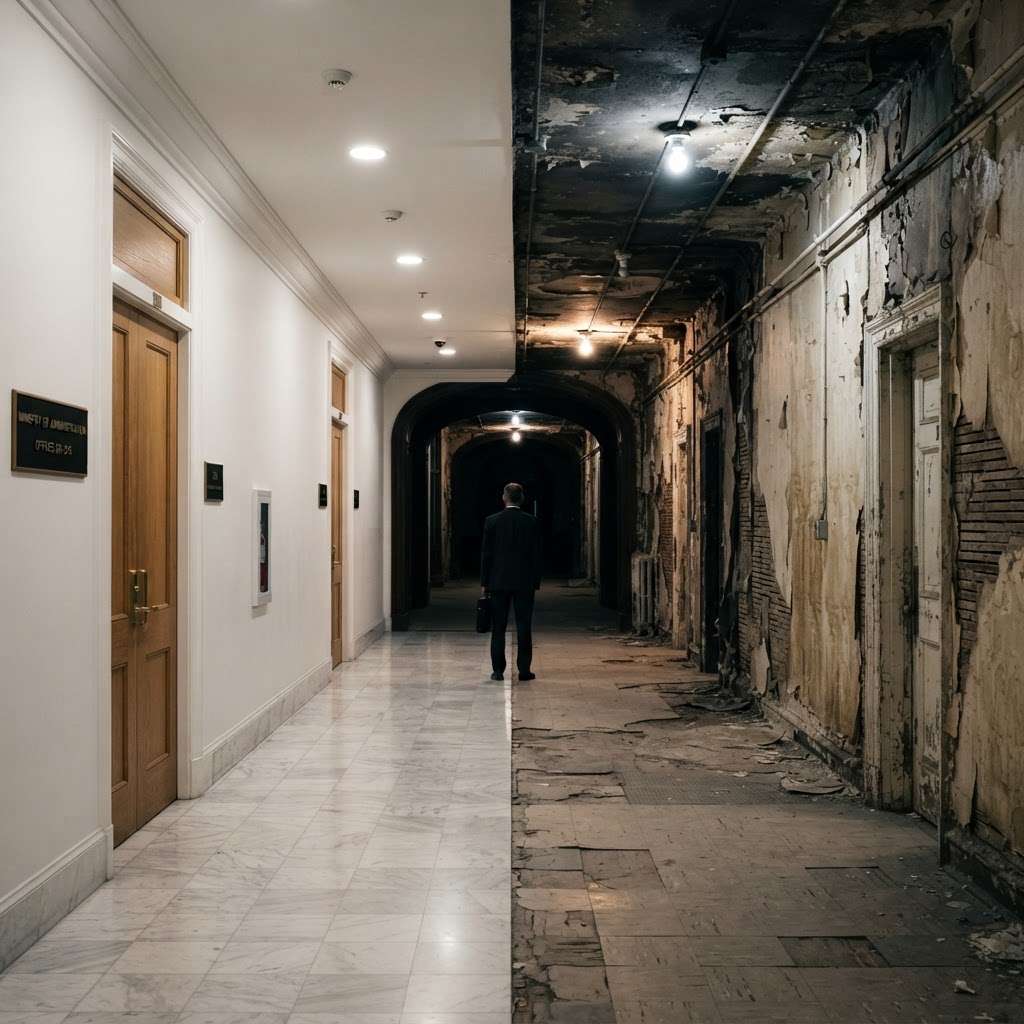
Political corruption is no longer an anomaly; it is the standard. From campaign finance influence to the decline of investigative journalism, the rot is systemic and intentional.
Talking Points: Public trust statistics, the 2025 CPI decline, systemic design vs. moral failure.
Only 33% of Americans trust the federal government today. That stat should scare you. When 67% of the populace openly labels the federal government as corrupt, we are past the point of casual concern. We are living in a house with a cracked foundation. The structure holds, but the rot is eating the load-bearing beams. Stop calling the system broken. It functions exactly as it was built to function. It is a design problem, not a moral one. Transparency International shows our CPI score dropped 12 points in a decade. We hit 64/100 in 2025. That is a freefall. We pretend this is just a blip on the radar of history. It is not. This is a deliberate, structural decay of our public institutions.
Talking Points: Institutional vs. regular corruption, the normalcy of malfeasance, why simple fixes fail.
Most people look for brown paper bags filled with cash. That is the old school way. Modern corruption is cleaner. It is sanitized by legal jargon and complex contracts. Scholars differentiate between regular, quid pro quo corruption and institutional corruption. The first is a bribe. The second is the system itself. Institutional corruption happens when organizations change their mission to serve private interests. It is often legal. It is the conflict of interest hiding in plain sight. If we think transparency is the cure, we are deluding ourselves. In a rigged system, exposing the rot makes people hopeless. They see the corruption and decide they might as well join in. This creates a cycle where honesty becomes a liability.
Talking Points: Citizens United fallout, dark money explosion, billionaire influence percentages.
I remember when local campaigns were about town hall meetings. Now, they are auctions. In 2024, billionaires dumped over $3 billion into federal races. That is 19% of all contributions. They aren’t donating out of the goodness of their hearts. They are buying policy. Since Citizens United, the dark money floodgates have burst. We are looking at $2 billion in untraceable cash for the 2024 cycle alone. This isn’t just influence. It is regulatory capture. If you own the lawmaker, you own the agency. If you own the agency, you write the rules. Your competitor? They never stood a chance.
Talking Points: Newspaper closures, the correlation between media decline and corruption, the oversight gap.
Look at your local paper. Oh wait, it is gone. Since 2005, we have lost 2,500 newspapers. One-third of the survivors will be dead by 2025. That is not just bad for journalists. It is a disaster for you. Research shows a clear link here. When a daily newspaper closes, federal corruption charges jump by nearly 7%. Journalists were our eyes and ears. They did the boring work of tracking public sector malfeasance. Without them, the thieves are working in the dark. We are living in news deserts. Corruption thrives in these barren landscapes. It grows like mold in a basement with no light.
Talking Points: Lack of teeth in watchdogs, the normalization of political patronage, administrative apathy.
I have seen oversight bodies wither away in real time. They have all the paperwork but no power. They become monuments to performative governance. Political patronage keeps them toothless. Why would a watchdog bite the hand that feeds it? We create commissions to look busy. They issue reports that nobody reads. These reports gather dust while the next scandal brews. Legislative transparency is a joke when the committees are filled with the same people they are supposed to regulate. It is a closed loop of self-interest. You cannot expect a guard dog to bark if it is busy eating the steak the burglar offered it.
Talking Points: Avoiding the single-villain narrative, institutional variables, the risk of blaming individuals.
We love to blame one guy. A rogue politician or a greedy donor. It makes us feel like we can just trim the branch and fix the tree. It is a lie. The tree is poisoned. You can swap the names on the ballot every two years. The behavior stays the same. The institutional variables dictate the outcome regardless of who holds the seat. If you put a saint in a cesspool, they will smell like sewage eventually. Focusing on bad apples ignores the barrel. This keeps us fighting each other instead of fixing the machinery. They love when we point fingers at each other.
Talking Points: The inadequacy of small reforms, political accountability hurdles, the necessity of deep change.
Incremental change is a sedative. They give us a tiny law to make us feel heard. It is designed to keep us quiet. Political accountability requires more than a new ethics form. We need structural reform in government. Real change would threaten the donors. It would cut the money trail. That is why they avoid it. Incrementalism is just a way to buy more time for the status quo. Don’t fall for the “better next time” promise. We have been hearing that for decades. The gap between promise and reality is widening.
Talking Points: Infrastructure decay, the cost of living crisis, the impact on daily life.
Corruption has a price tag. You pay it every time you fill your gas tank or pay your taxes. Public services are shrinking because the money goes to special interests. Our roads crumble. Our water systems fail. Our schools are starved. We pay for services we don’t get. This isn’t abstract politics. This is your life. The money that should fix your street went to a lobbyist’s vacation home. Apathy is the accomplice to this theft. When we shrug, they win. They count on us being too tired to care.
Talking Points: Examining specific mechanics, identifying common threads, patterns of failure.
Look at any recent major scandal. The pattern is always the same. A project gets approved with no public input. A donor gets a massive contract. The oversight body ignores the clear conflict of interest. The news reports are buried or ignored. It happens again and again. These aren’t isolated events. They are case studies in a broken business model. They act like they are surprised when caught. They are not surprised. They are calculating the risk-to-reward ratio. Usually, the reward is worth the small fine they might pay later.
Talking Points: Moving past cynicism, the role of individual engagement, starting a conversation.
We have to stop accepting this as the new normal. Cynicism is easy, but it won’t change the outcome. We need to be loud about the specific failures we see. Start local. Demand records. Show up to meetings. The system is designed to discourage you. That is your cue to keep showing up. If we don’t hold them accountable, nobody will. We have the data and we see the pattern. Now we need the collective will to change the design. What is one thing you have seen in your community that smells off? Drop it in the comments below. Let’s start tracking the rot for real.