




Newsletter Subscribe
Join thousands of readers who get our Sunday Briefing: one email, five essential stories, zero fluff. Subscribe NOW!
A deep, cynical look at why government corruption investigations are often performative and how the system protects itself from real accountability.
Talking Points: Public perception vs. reality of oversight. How political interests paralyze investigations. * Why cynicism is a tool for truth.
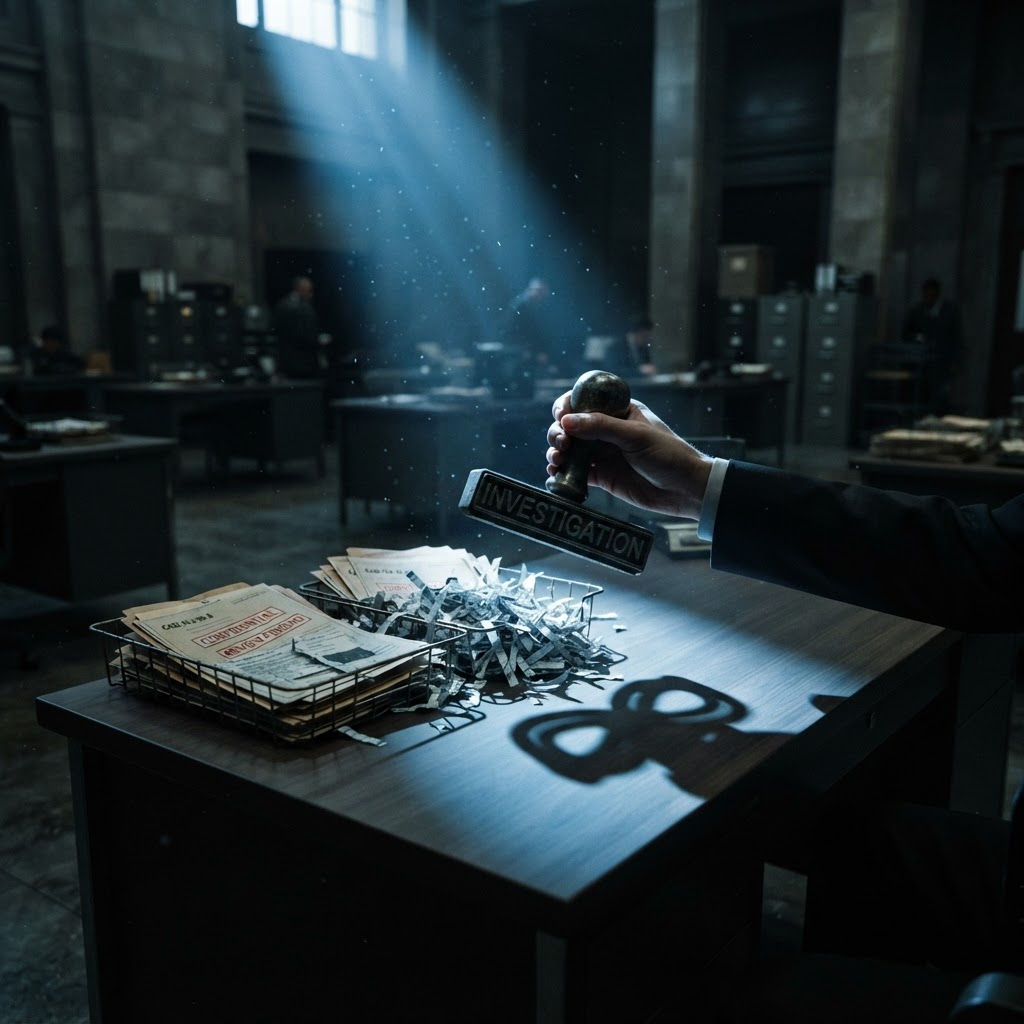
Every time a scandal breaks, the public demands answers. We watch the nightly news, waiting for the inevitable promise of a formal government corruption investigation. It is a pantomime. We act as if these inquiries aim to expose the rot. They actually serve to sanitize it. I have spent decades watching these circus acts play out from the front row. They are designed to fail. When the system investigates itself, the outcome is baked into the cake.
Talking Points: Standard procedure in a capture scenario. The performative nature of questioning. * How evidence is sanitized before public release.
I recall watching a state-level probe into a kickback scheme years ago. The investigators were colleagues of the accused. The process was painfully slow. They spent months checking boxes and filling forms. Then they concluded with a shrug and a sanitized report. Nothing changed. The system protects its own. Real accountability disappears when the people holding the pen are on the same payroll as the people being investigated.
Talking Points: Conflict of interest in oversight bodies. How anti-corruption agencies effectiveness drops under pressure. * The internal bias of permanent staff.
Anti-corruption agencies are often just window dressing. They operate within a hierarchy that demands loyalty over truth. When institutional corruption takes root, it is nearly impossible for a junior staffer to challenge a senior official. You either play along or you are pushed out. The gatekeepers are trapped in a dilemma. Keep your job or expose the truth. Most choose the mortgage payment every time.
Talking Points: How legislative immunity hampers justice. The role of cronyism in stalling probes. * Legal barriers as a shield for the guilty.
Laws are often written by the very people who benefit from keeping things quiet. We see elaborate legislative ethics codes that sound great on paper. In practice, they are hurdles designed to be cleared only by the most reckless. If you happen to be well-connected, you are shielded by layers of legal bureaucracy. It is a masterclass in deflection.
Talking Points: Political interference in justice. Why independent commissions often fail. * The illusion of checks and balances.
We love the idea of the independent commission. It sounds fair. It looks professional. Yet, the leadership of these groups is usually appointed by the people being watched. You cannot expect a watchdog to bite the hand that appoints it. True independence is a fairy tale we tell ourselves to feel better about the state of our republic.
Talking Points: External pressure as the only motivator. How public outrage can force a real probe. * Cases where system failure leads to accidental truth.
Sometimes, the system slips up. Maybe a leak is too big to ignore. Or a rival faction decides to settle a score by tossing someone under the bus. These rare cases are not the result of a functional system. They are the result of political cannibalism. It is not justice. It is just the trash taking itself out.
Talking Points: Whistleblower protection challenges. Why internal reporting rarely leads to change. * The personal cost of honesty.
People think whistleblowers are the heroes of our age. They are often just the first people to be fired. The process for reporting graft is usually a trap. It signals your intent to your superiors before anything can be done. I have seen good people ruin their careers for a memo that went straight into a shredder. It takes more than a tip to move the needle.
Talking Points: Why journalists rarely dig deep. Dependence on official sources. * How the media frames failures as anomalies.
Journalists are often just stenographers for the powerful. They wait for the official press release. They ignore the pattern of public sector graft that stretches back for decades. Instead, they focus on the personality of the offender. It is easier to report on a person than to dissect a system. That is why the headlines keep changing while the status quo stays rock solid.
Talking Points: The 2023 statistics on conviction rates. Regional disparities in justice. * International financial flows hiding the loot.
We lost 19.1 percent of our federal official corruption convictions compared to 2019. That is not because there is less graft. It is because the appetite for enforcement has withered. The $3.6 trillion cost of global corruption is the tax we all pay for looking away. We allow our financial systems to act as the getaway car for stolen funds from overseas. It is a global racket.
Talking Points: Why we must remain vigilant. Rejecting the hope for system repair. * Moving toward local-level scrutiny.
Expect nothing from the top. The fish rots from the head. If you want to see change, look at your local council or your school board. Corruption survives on our indifference. Keep asking the hard questions. Keep looking at the receipts. If you have seen the system fail or caught a glimpse of real accountability, share your story. Let us hear what you have seen in the comments below.
1. Question: Why do corruption convictions keep falling? Answer: The decline is largely driven by a lack of political willpower and the systemic capture of investigative agencies that prefer to keep quiet. 2. Question: Are anti-corruption agencies ever truly effective? Answer: They rarely succeed without massive external public pressure because they are usually staffed and funded by the very entities they are supposed to monitor. 3. Question: What is the biggest barrier to exposing corruption? Answer: The biggest barrier is the lack of genuine protection for those who speak out, coupled with complex legal immunities that shield officials. 4. Question: Does the media help stop corruption? Answer: Often, the media acts as a bystander that prioritizes access to officials over rigorous investigation, failing to challenge the status quo. 5. Question: How can regular people make a difference? Answer: Focus on local issues where records are more accessible and your voice carries more weight, forcing small changes that eventually accumulate.