







Newsletter Subscribe
Join thousands of readers who get our Sunday Briefing: one email, five essential stories, zero fluff. Subscribe NOW!

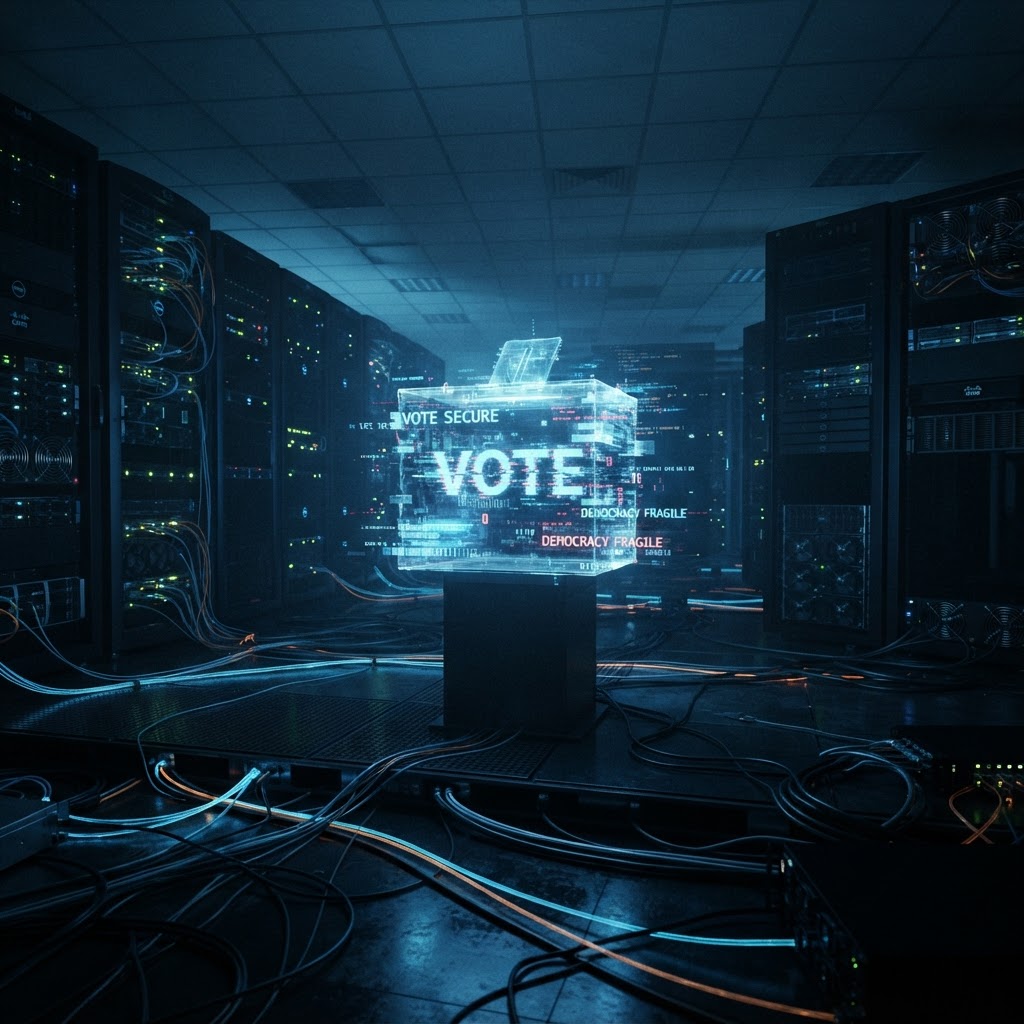
Election security is a broken promise of technology. Learn why relying on machines instead of paper is a losing game for democracy.
Talking Points:
* The performative nature of electoral theater.
* Why our current systems favor optics over safety.
* The dangerous obsession with high-tech solutions.
Democracy is a fragile theater. We act like the ballot box is a magic portal that turns paper into truth. It is not. I have spent years looking at how we manage our elections, and the more I see, the less I trust the machinery. We are obsessed with gadgets and digital upgrades, ignoring that the real threat is our own need for convenience.
We love to believe that technology fixes human error. It usually just hides it behind a screen. Election cyber security threats are not just about hackers in hoodies. They are about the fact that we have built a brittle, high-stakes system that relies on trust, not verification. We are betting the house on software we barely understand.
Talking Points:
* The fallacy of total isolation for voting machines.
* Why connectivity sneaks into secure environments.
* The gap between policy and daily practice.
Experts tell us that voting machines are air-gapped. That means they stay offline. It sounds safe on paper. In practice, it is a lie. I remember talking to a local official who swore his machines never touched the internet. Then he mentioned needing to update the electronic pollbooks in real time.
See the problem? As soon as you need to sync voter data vulnerabilities with a central server, your air gap is gone. You now have a point of entry. Once a system has a physical port, it is just a matter of time before someone plugs in the wrong thumb drive. We are operating on a fantasy of total isolation.
Talking Points:
* Centralized records as prime targets.
* The constant churn of voter registration data.
* Why securing one endpoint is never enough.
Your voter registration database is the soft underbelly of the process. Think about it. This data sits on servers that must be accessed by hundreds of poll workers. It is not some locked vault. It is a messy, sprawling network of active files.
Foreign interference in elections often starts here. If you can delete or change records, you create chaos. You do not even need to touch the actual ballots to ruin an election night. You just need to make people wait in line for six hours because their name is missing. That is effective manipulation.
Talking Points:
* Why digital noise is more effective than hacking.
* The difficulty of countering election misinformation campaigns.
* How distrust becomes a self-fulfilling prophecy.
We worry about hackers. We should worry about liars. Disinformation vectors are far more damaging than a technical glitch in a precinct. When a bad actor seeds a rumor that a system is rigged, they win. They have destroyed faith in the result without moving a single vote.
These election misinformation campaigns are cheap to run. They are social engineering at scale. The goal is not to win an election. The goal is to make us hate each other until we stop believing the system matters at all. It is working.
Talking Points:
* The difficulty of proving who did what.
* Why state-sponsored actors stay in the shadows.
* The strategic benefit of plausible deniability.
Who is doing this? Everyone points fingers, but threat actor attribution is a black hole. You can find code that looks like it came from a specific country. Does that prove their government sent it? No. It proves they bought the right malware.
It is a game of masks. A state-sponsored actor can launch an attack and make it look like a disgruntled teenager. This ambiguity makes critical infrastructure protection a nightmare. How do you defend against an enemy you cannot name? You usually end up defending nothing very well.
Talking Points:
* Why people are the weakest security link.
* The reality of phishing and administrative errors.
* How stress and low pay create security risks.
Computers are predictable. People are a disaster. When you ask a part-time volunteer to manage complex election infrastructure security, you are asking for trouble. They get tired. They get confused. They click the wrong link in a phishing email.
Social engineering is the oldest trick in the book. A simple phone call to a stressed clerk can reveal passwords or administrative workflows. We spent millions on software but pennies on training the humans running the machines. It is pure institutional negligence.
Talking Points:* Why decentralized systems suffer from inconsistency.
* The impact of budget cuts on security.
* The high turnover of election staff.
We have thousands of counties running their own show. The Bipartisan Policy Center points out that this decentralization protects us from a single kill switch. But it also means that security is only as strong as the poorest county in the state. That is a massive weakness.
Staff turnover is brutal. When your lead technician quits every two years because of harassment, who is left to watch the store? 38% of our election workers face real threats now. We are losing the people who actually know how to lock the doors.
Talking Points:
* Why showing how things work can be dangerous.
* The balance between public trust and operational security.
* Why zero-trust architecture is hard to implement.
We want transparency. We want to see the code. But if you show the world exactly how your ballot system is built, you give the attackers a roadmap. It is a paradox that keeps me up at night. You cannot be perfectly open and perfectly secure at the same time.
We talk about zero-trust architecture as the gold standard. In practice, that is expensive and hard. Most local governments do not have the budget or the talent to build it. They are doing the best they can with what they have, which is often not enough.
Talking Points:
* The limitations of digital voting.
* Why paper ballots are the only real safety.
* Accepting that risk is part of the game.
Can we ever have a perfectly secure election? No. Stop looking for saviors. If we want safety, we go back to paper. Human-readable paper ballots are the only thing we have that cannot be hacked over a network. Everything else is just adding layers of risk for the sake of speed.
We need to lower our expectations. If we want digital voting, we accept the digital risks. We stop pretending that we can make a voting machine as secure as a bank vault. We focus on resilient electoral processes, not perfection.
We need to stop waiting for a technological savior to fix our elections. There is no patch for human nature or political division. We rely on old paper and smart people. If we can’t trust the process, we have to demand better human oversight, not just better hardware.
What are you seeing in your local district? Are your officials focusing on real human processes or just buying more expensive gear? Share your thoughts below. Let’s get real about what it takes to protect a vote.
1. Are electronic voting machines inherently unsafe? They have risks due to software, but they aren’t ‘hackable’ in a way that shifts federal outcomes today. The real danger is our reliance on them instead of paper.
2. Why not just move all voting to the internet? It is a death trap. Online voting creates a massive target for state-sponsored attacks that we have no way to defend against currently.
3. Is a paper ballot really better than a digital one? Yes, because you cannot use a remote exploit to change ink on a piece of paper. It forces attackers to do the work physically, which is much harder to hide.
4. What can regular citizens do to help election security? Volunteer as a poll worker. The more eyes on the physical process, the harder it is to pull off any kind of manipulation or mistake.
5. Should I be worried about my voter registration data? Yes, but treat it like any other data breach. Keep an eye on your status, report discrepancies, and realize that while it’s annoying, it doesn’t change the physical ballot you cast.