






Newsletter Subscribe
Join thousands of readers who get our Sunday Briefing: one email, five essential stories, zero fluff. Subscribe NOW!

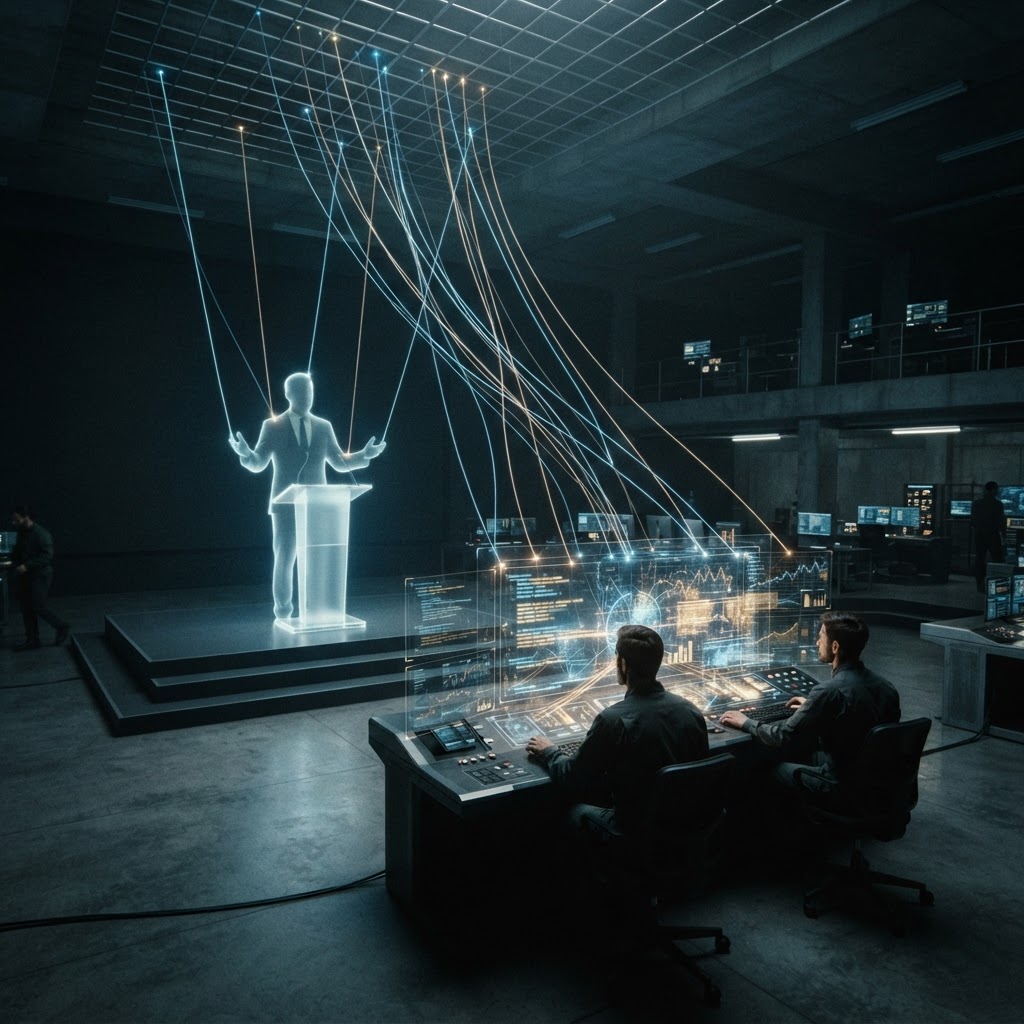
Political campaigns are being transformed by AI, turning elections into a digital puppet show of micro-targeting and synthetic influence. Learn how to reclaim your independence.
Seventy-eight percent of Americans suspected AI would rig their 2024 election. That is a staggering number of people watching the theater unfold with total distrust. I remember looking at my own feed during a primary and feeling like my brain was being pulled in five directions at once. The impact of AI on political campaigns is not some distant sci-fi nightmare anymore; it is the blunt instrument of modern political combat.
Talking Points:
Political consultants are obsessed with speed. I have watched them swap out veteran strategists for automated tools that grind through data all night long. The AAPC reported that most consultants are now using generative AI for brainstorming and research every single week. It is efficient, sure. It is also stripping the human friction out of political messaging.
This is not just about writing better emails. It is about computational propaganda. When an entire campaign strategy is built by a machine optimizing for engagement, the truth often becomes an inconvenient variable. We see AI in election interference becoming the standard operating procedure for those who prefer outcomes over ethics.
Talking Points:
I once spoke to a campaign manager who bragged about knowing a voter’s hidden fears before they even stepped into the booth. AI-driven political micro-targeting makes this possible by mapping our digital footprints with terrifying precision. They use surveillance capitalism to build a profile that knows your habits and your grudges.
They take this data and feed it into models post-trained for persuasion. These models can be up to 51% more convincing than those trained on neutral data. Imagine getting an ad that hits your specific soft spot every single time you open your phone. You aren’t just seeing an ad; you are being poked by a machine.
Talking Points:
In 2024, nearly every country holding competitive elections dealt with some form of synthetic media incident. We are talking about audio and video that looks real enough to pass the coffee-shop test. Deepfakes in elections are the perfect tool for discrediting an opponent when the truth is too slow to catch up to the lie.
I find it exhausting to verify everything I see. You probably do, too. That exhaustion is part of the point. If we stop believing our eyes, we stop caring about facts entirely. It is a win for the manipulators who want us to stay stuck in a loop of confusion.
Talking Points:
Chatbots can churn out dense, persuasive arguments at a rate no human writer could ever match. A study from the LSE showed these arguments are very effective at changing opinions, even if the facts are flimsy. We are essentially watching public opinion engineering happening in real-time on our social feeds.
People think they are talking to a neighbor online when they are really arguing with a script. It makes consensus feel organic when it is completely synthetic. The impact of AI on political campaigns shows up right here, in the quietest corners of our online conversations.
Talking Points:
We all love to think we are independent thinkers. Yet, our digital environments are curated by systems that only show us what we want to hear. These echo chambers turn normal disagreement into digital warfare. The machine learns that anger keeps us clicking, so it feeds us more rage.
This algorithmic bias creates a feedback loop that pushes people toward the fringes. It is a slow, steady drift. Before you know it, your neighbor across the street might as well be living on a different planet because your news feeds are completely distinct realities.
Talking Points:
Politicians are scrambling to look like they are doing something about the impact of AI on political campaigns. Thirty-one states have passed laws on deepfakes, but these are just band-aids on a gunshot wound. Most of these laws focus on disclosures, which do nothing to stop a persistent liar.
Many of these rules face massive legal hurdles. They also ignore the fact that the tools are already out there for anyone to use anonymously. You cannot regulate a ghost. The tech is moving faster than any courtroom could ever hope to keep up with.
Talking Points:
Everything in politics now has a price tag attached to the data. Democracy is becoming a market where the highest bidder buys the most efficient AI model. It is not about winning an argument anymore; it is about winning the algorithm.
I struggle with the idea that our votes are being commodified by developers in Silicon Valley. We are the raw material for their next iteration of political influence. If we don’t wake up, we are just audience members in a puppet show we are paying to watch.
Talking Points:
I keep a simple rule: if a political post makes me want to scream, I step away. Your brain is not built to handle the constant, AI-curated outrage. You have to actively fight back against these systems by seeking out slow, boring, long-form information.
Start treating your attention like a bank account. Don’t spend it on every provocative headline that pops up. The more you step out of the algorithmic stream, the less power they have over you. It is the only way to keep your head in a synthetic world.
We are living through a massive shift in how political power is maintained. The impact of AI on political campaigns is not going away; it is just getting quieter and more precise. You don’t have to be a tech expert to see the patterns, but you do have to be a skeptic.
Take a moment to look at your news feed today and ask who benefit from your reaction. Share your own tips for staying grounded in the comments below. Let us stop letting the machine run the show.
1. How can I tell if a political ad was generated by AI? Look for tiny imperfections in fingers, text, or shadows, but know that these are disappearing fast; skepticism is your best filter.
2. Do AI chatbots really change how people vote? Studies suggest they are highly persuasive at shifting views on specific issues, though a single chat session rarely flips a whole campaign outcome.
3. Are there laws preventing deepfakes in elections? Yes, many states now require disclosures on synthetic content, but enforcement is difficult because many bad actors operate outside of legal jurisdictions.
4. Why do recommendation systems make political division worse? These systems prioritize engagement, and since divisive content usually gets more clicks, the algorithm naturally surfaces more of it to keep you active.
5. Can I opt out of AI-driven political targeting? While you cannot stop the targeting entirely, you can limit your data exposure by using private browsers, blocking trackers, and ignoring political engagement bait.