







Newsletter Subscribe
Join thousands of readers who get our Sunday Briefing: one email, five essential stories, zero fluff. Subscribe NOW!

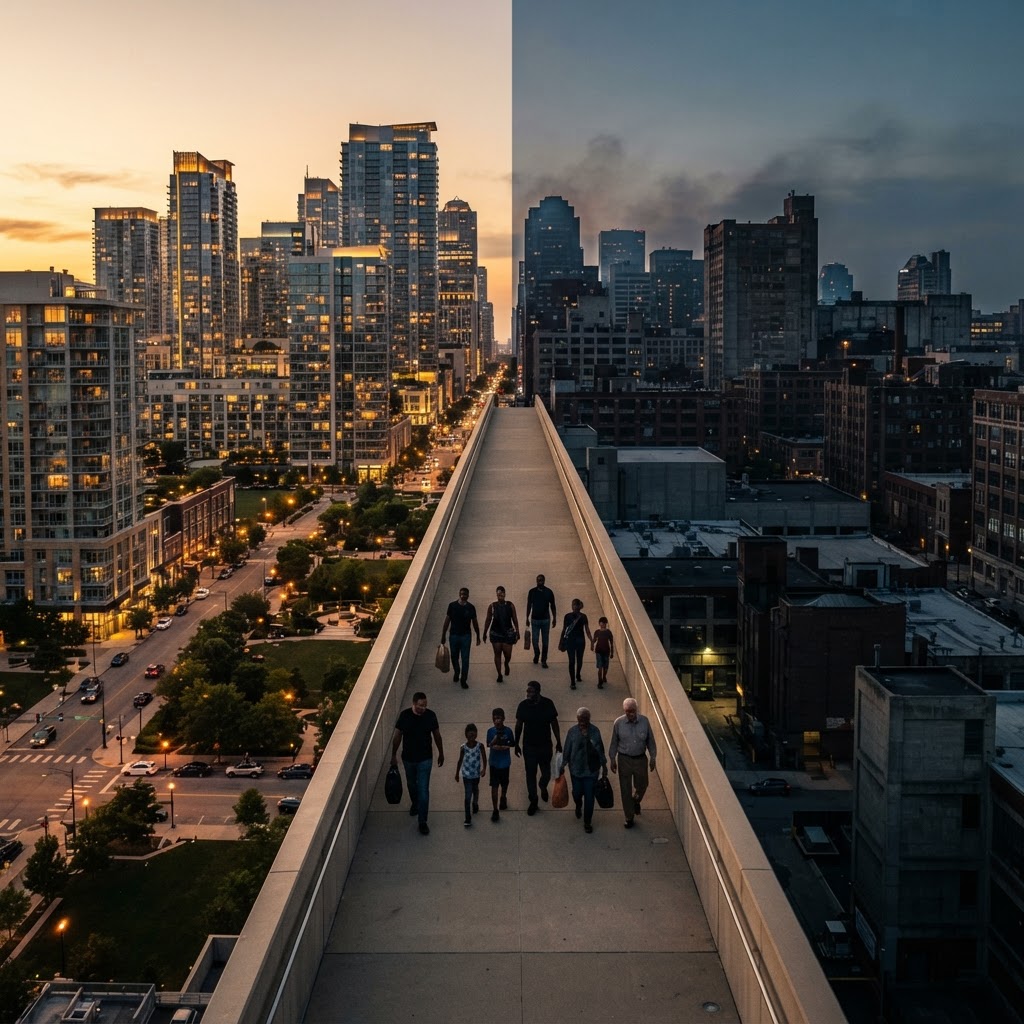
Economic inequality statistics 2026 reveal a broken system. From the 0.001% detachment to the crushing reality of the bottom 50%, we analyze why the myth of meritocracy is failing everyone.
I remember sitting in a college economics lecture forty years ago, listening to a professor insist that if you work hard, you get ahead. I believed him. It was a comfortable story. Looking at the data now, I realize that old dream is dead. We live in a world where the floor is rotting beneath the feet of millions while a few float in orbit. Economic inequality statistics 2026 paint a picture of a system that has stopped pretending it is fair. We need to stop buying the lie that wealth is just a reward for effort.
Talking Points:
We love to talk about meritocracy as if it were a natural law. It is not. It is a convenient fairy tale told by those who started the race at the finish line. When I look at the data, I see the same old patterns of intergenerational poverty blocking millions from ever finding a real foothold. The game is rigged by those who write the rules.
Social mobility has flatlined. You cannot pull yourself up by your bootstraps if you have no boots. The cost of education, housing, and healthcare has outpaced the average wage for decades. This isn’t a glitch in the system. It is the system working exactly as it was built.
Talking Points:
The latest World Inequality Report 2026 findings are a punch to the gut. The top 10% of the global population owns 75% of all wealth. That is staggering. Meanwhile, the bottom 50% clings to just 2%. Think about that for a second. We are watching the largest transfer of capital accumulation in history happen in real-time.
Wealth concentration statistics show this isn’t just about money. It is about influence. When 1% of global GDP flows from poorer to richer nations every year, it isn’t an accident. It is an exorbitant privilege baked into global trade. We call it growth, but for most, it is just theft.
Talking Points:
The top 1% of the global population controls 37% of global wealth. That is 18 times more than the bottom 50% combined. These people have literally detached from the reality of the rest of us. They don’t participate in the same economy. They live in a world of tax-advantaged assets and global capital flows.
They don’t pay taxes like you or I. They move money through layers of shells and trusts. It makes my blood boil. We have allowed a class of ultra-high-net-worth individuals to write their own laws. They aren’t contributing to the collective; they are siphoning it dry.
Talking Points:
For half the planet, survival is the only goal. When you spend every waking moment worrying about rent, food, and heat, you cannot build wealth. You are stuck in a loop of subsistence. I have watched neighbors work three jobs only to fall further behind every year.
Social safety net erosion has left millions exposed to every market fluctuation. We stripped away the protections that once gave people a fighting chance. Now, we act surprised when the cracks in our society turn into craters. If you cannot afford to fail, you can never take the risks needed to thrive.
Talking Points:
We ignore the backbone of the economy. Women earn only 32% of what men earn when we include unpaid domestic labor. If you pull out that unpaid work, the figure jumps to 61%. That is still a disaster. It shows how much of our global prosperity rests on stolen time.
Men get paid for their output. Women often get paid nothing for the work that keeps families and communities alive. This isn’t just a social issue. It is a massive economic misallocation. We are wasting half our talent pool because we don’t want to value the labor that isn’t easily tradable on a market.
Talking Points:
Education used to be the great equalizer. That died long ago. In Sub-Saharan Africa, we spend about €200 per child. In North America and Oceania, that number is €9,000. How can we expect a fair outcome when the starting line is in a different universe?
If you grow up in a zip code with crumbling schools, you are fighting a losing battle. My own path was helped by teachers who actually cared and resources that were available to everyone. Today, those resources are paywalled. We are essentially selecting for wealth before a child even hits adulthood.
Talking Points:
Money is speech in 2026. If you have enough, you can buy a megaphone that drowns out everyone else. We see it in every legislative session. The wealthy push for tax cuts and deregulation while everyone else fights over crumbs.
Democratic fragmentation is the inevitable result. When the average person realizes the system is bought, they stop participating. Why vote when the options are just two sides of the same donor-funded coin? We need to disconnect campaign finance from public policy, but those in power will never let it happen.
Talking Points:
The top 0.1% are responsible for 298 tons of CO2 annually. The bottom 50%? Less than one. Yet, who suffers when the floods come? It is never the ones living in climate-controlled bunkers. It is the people who have the least.
We talk about green transitions as if they are a shared burden. They are not. The costs fall on the poor, while the benefits of new technology are hoarded by the top. We are letting the people who broke the climate off the hook while charging the victims for the cleanup.
Talking Points:
I am tired of hearing that inequality is just what happens. It isn’t. It is a series of choices. We chose to cut taxes for the rich. We chose to erode labor rights. We chose to underfund public services. We can choose differently.
US wealth gap trends can be reversed if we actually want to. A real wealth tax, stronger unions, and guaranteed public investment could change everything in a decade. We just need the guts to stop protecting the people who don’t need protecting. This is about power, not resources.
Talking Points:
The numbers are clear. The system is failing most of us. You have the power to stop believing the lie that your struggle is your own failure. It is a systemic outcome of the choices made by those who control the levers of power.
Start by questioning everything. Stop voting for anyone who doesn’t address the root causes of our economic decay. Organize. Share what you know with your community. We need to demand a shift that centers people, not just capital. Leave a comment below with your thoughts on how we can break this cycle—I want to hear what you are seeing in your own town.
Question: Why do economic inequality statistics 2026 show such a wide gap compared to past decades?
Answer: The gap is widening because of policy choices like tax cuts, deregulation, and the intentional erosion of labor unions, combined with the extreme concentration of capital in high-return asset classes.
Question: Is there any truth to the idea that modern technology creates more inequality?
Answer: Technology itself is neutral, but how it is owned matters. When proprietary software and AI are concentrated in the hands of a few, the gains from productivity flow to owners rather than workers.
Question: How does the US wealth gap compare to global trends?
Answer: The US is leading the charge in wealth concentration, with a Gini coefficient at a 60-year high in 2026, though the trend of capital capture by the top 1% is a global phenomenon across almost all major economies.
Question: Can redistributive policy actually work in a globalized economy?
Answer: Yes, but it requires coordinated international efforts to stop tax havens and ensure multinational corporations pay their fair share where they actually conduct their business, rather than where they park their paper assets.
Question: What is the most effective way for an individual to challenge current inequality?
Answer: Organize locally, support labor rights, and advocate for specific policy changes that target wealth concentration, like robust wealth taxes and universal access to high-quality public services.