







Newsletter Subscribe
Join thousands of readers who get our Sunday Briefing: one email, five essential stories, zero fluff. Subscribe NOW!

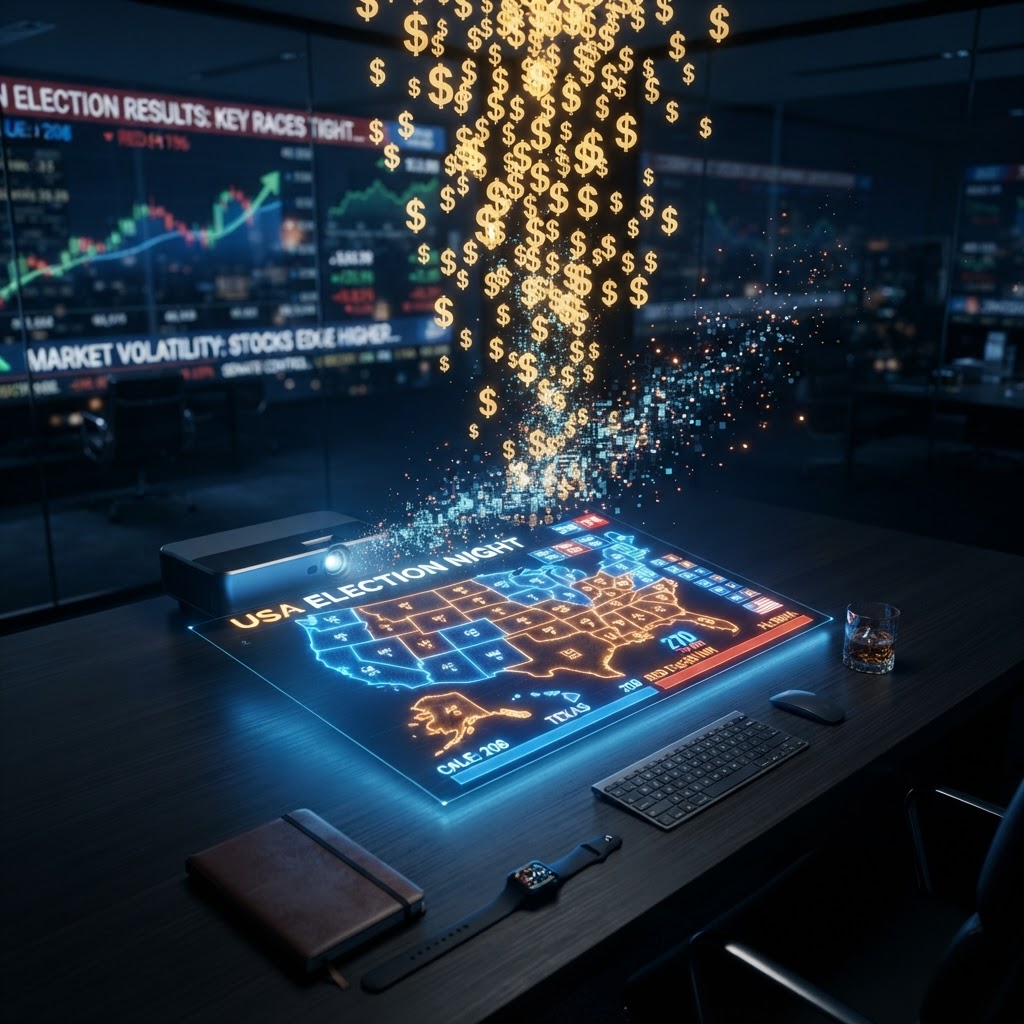
With political ad spending projected to hit $11.6 billion, we examine why this massive investment in digital noise is a failing racket that yields minimal results for voters.
Talking Points: Projected record-breaking spend, the illusion of persuasion, questioning the ROI of political media.
Eleven billion dollars buys a lot of silence. Instead, we get a deafening roar of talking heads, manufactured outrage, and grainy graphics that do nothing but clutter our screens. The 2026 midterm election cycle is set to incinerate $11.6 billion on advertisements. That figure eclipses the 2024 presidential spending, proving that we have traded policy for pure noise. I have spent two decades watching this money burn. It never buys clarity. It only buys confusion.
We pretend this is an essential part of the democratic process. It is not. It is an industry built on the assumption that if you repeat a lie loud enough, people will eventually agree. The data suggests otherwise. Academic research consistently shows that these ads move the needle about as much as a pebble affects a tidal wave. Yet, the checks keep getting written. The consultants keep getting paid. We are the ones footing the bill in lost time and sanity.
Talking Points: Scientific consensus on low persuasion, voter inertia, the failure of algorithmic influence.
I remember sitting in a war room back in the day, listening to a high-priced strategist explain how his new spot would flip a key district. He talked about “voter persuasion metrics” as if they were law. He was full of it. That Yale-led meta-analysis from 2020 was a wake-up call that the industry ignored. Political ads have negligible effects on preferences. Most voters made up their minds long before the first ad hit the screen.
We cling to the idea that we can change minds. It keeps the campaign digital marketing budget flowing. If campaigns admitted their ads did nothing, the business model would collapse. People are stubborn, and they prefer their own echo chambers. Algorithm-driven persuasion is just a shiny label for selling confirmation bias to the highest bidder. It is not science; it is sophisticated gambling with donor money.
Talking Points: Linear TV displacement, the rise of connected TV, the economics of political media buying.
Money moves where the eyeballs go. It used to be local news broadcasts. Now, the cool kids are obsessed with connected TV political ads. We are looking at $2.5 billion directed at streaming platforms for this cycle alone. That is more than double the 2022 midterms. It is a desperate scramble to find anyone who is still watching live content.
This shift creates a weird tension in the ad tech market. Linear TV used to be the gold standard for reaching older, reliable voters. Now, campaigns are trying to mirror that dominance on streaming services. The inventory is squeezed. It drives up prices for everyone else while delivering questionable engagement. You end up paying a premium for a viewer who probably stepped away to grab a beer during the break.
Talking Points: Granular commodities, the erosion of privacy, voter mobilization tactics.
We are treated like data points. Campaigns talk about “voter targeting data privacy” in private meetings, but they ignore it in public practice. They slice and dice our habits until we are just a series of predictive behaviors. Your browsing history is sold to a PAC, and then you see an ad for a candidate you despise. It feels personal because it is.
This level of surveillance is unnecessary. Most people just want to know where a candidate stands on a road repair project or school funding. Instead, they get hyper-targeted sludge designed to trigger an emotional response. It is invasive. It is cheap. And it does not actually mobilize anyone who wasn’t already going to vote.
Talking Points: Crowding out small businesses, local ad market saturation, the zero-sum game of ad inventory.
When a campaign floods the zone, the local car dealership loses. The small restaurant trying to run a promo gets pushed out by a massive influx of political cash. We saw this in 2021; political spending crowds out specific local categories. It creates an artificial inflation in the cost of reaching local audiences. That is a tax on local commerce.
Political ad impact analysis shows us that while the broader market survives, the local landscape takes a hit. We lose commercial diversity. Our airwaves are monopolized by entities that have zero interest in the community. They are only here to win a seat. Once the election is over, they vanish, leaving the local ad economy to rebuild from the rubble.
Talking Points: The advertiser’s dilemma, political ad clutter, balancing news and politics.
If I were running a brand today, I would stay far away from news. It is a minefield. You run a spot for your soap next to a fire-and-brimstone attack ad, and your brand values get stained by proximity. Advertisers are caught in an impossible squeeze. They want the reach, but they don’t want the baggage. It is the definition of brand safety in a post-truth environment.
Political ad clutter makes it impossible for normal brands to be heard. You are fighting for attention against a $11.6 billion machine. Most people are just tuning out everything. It is a defensive reaction. We learn to ignore the screen to save our sanity. Who can blame us?
Talking Points: Synthetic creative, misinformation concerns, the tech-investor PAC influence.
Artificial intelligence is the new hammer for these campaigns. It is cheap, it is fast, and it is largely unchecked. We have AI-related industry super PACs throwing $275 million into the pot to make sure their synthetic creative gets seen. Eighty-five percent of Americans fear this stuff is just spreading garbage. They are right to be worried.
It is scaling the noise. We are not getting better information; we are getting faster lies. When you can generate a thousand versions of an attack ad for pennies, you don’t need to be accurate. You just need to be loud. It is the ultimate degradation of political discourse. A race to the bottom that we are all losing.
Talking Points: Campaign finance transparency issues, the zero-sum nature of elections, the power of incumbency.
Why do they spend it? Because it works just enough. If an extra million buys one seat, that seat is worth billions in legislative power. It is a rational choice for an irrational system. Campaign finance transparency is a nice idea on paper, but the money always finds a way. The system is designed to reward the highest bidder.
It is a zero-sum game where the currency is your focus. If they don’t spend it, their opponent will. So, the spending never stops. It just expands to fill the available digital space. We are stuck in a loop of escalating costs and diminishing returns. The only winners are the media buyers and the ad tech platforms.
Talking Points: Reclaiming personal space, the role of voters, final thoughts on ad fatigue.
We are being shortchanged. We pay for the internet with our attention, and we get flooded with junk. You have the power to turn it off. Use an ad blocker. Delete the apps. Choose your news sources with a critical eye. If we stop playing the game, the racket stops making sense.
Don’t let them win by default. Talk to your neighbors directly. Look up local records. Do the boring work of being a citizen. It is much more effective than watching a thirty-second spot produced by a shell company in another state. Let me know what you think in the comments. Are you seeing this madness in your feeds too?
1. Question: Do political ads really change how people vote? Answer: Evidence shows their influence is consistently small. Most voters are locked into their choices, and ads usually just reinforce what they already think.
2. Question: How does political spending affect local small businesses? Answer: It creates local ad market saturation that forces small businesses to pay more for inventory or get pushed out of key time slots by better-funded campaigns.
3. Question: Why is spending on connected TV increasing so rapidly? Answer: Campaigns are following the audience. As viewers move away from cable to streaming platforms, campaigns shift their budgets to reach these fragmented, yet highly targeted, demographics.
4. Question: Is there a way to stop AI from spreading election misinformation? Answer: Current regulations are fragmented and slow. Relying on disclosure is difficult because the technology allows for rapid creation and dissemination of synthetic content before regulators can react.
5. Question: What can voters do to avoid political ad manipulation? Answer: Use ad-blocking software, limit time on social media platforms during election cycles, and seek out neutral, primary-source information to make decisions instead of relying on paid messaging.