





Newsletter Subscribe
Join thousands of readers who get our Sunday Briefing: one email, five essential stories, zero fluff. Subscribe NOW!
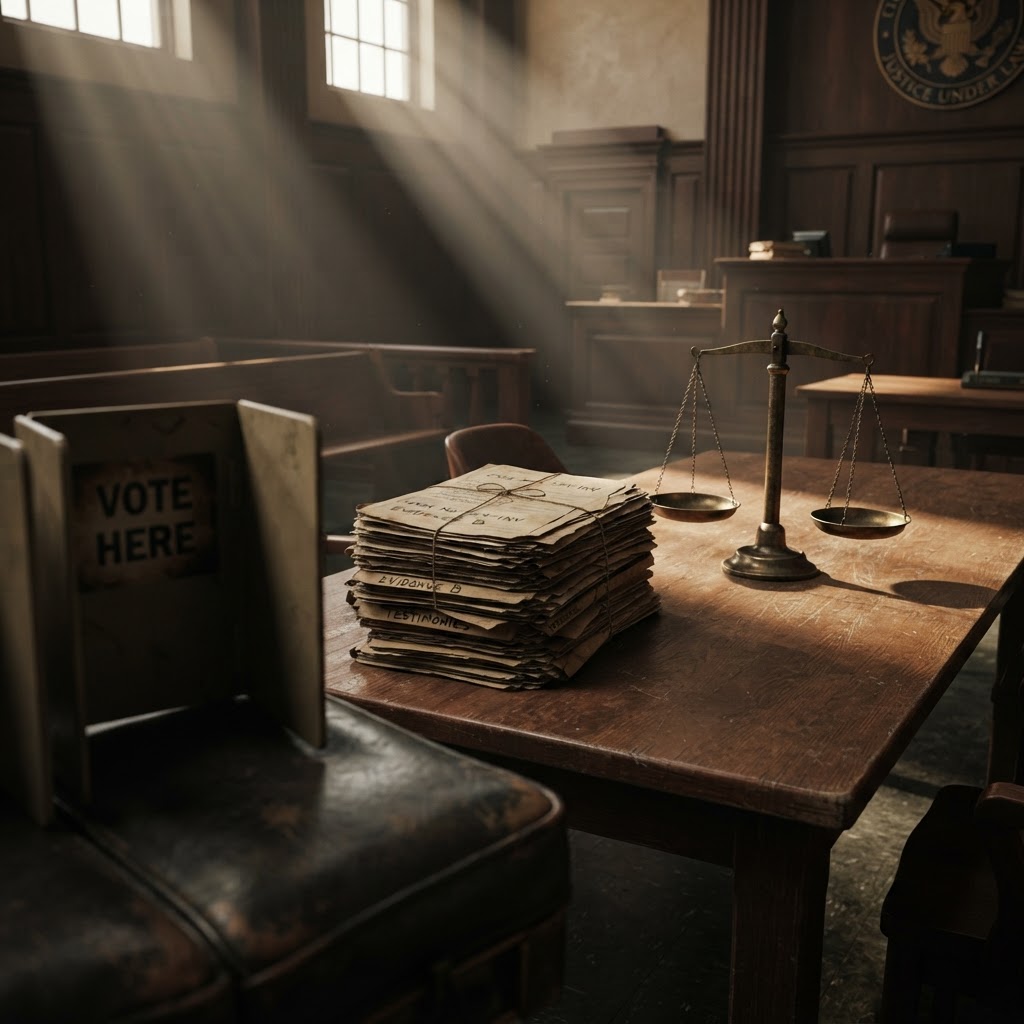
The judicial system is not a savior for the ballot box. I examine why relying on federal lawsuits for voting rights is a dangerous mistake and what we should be doing instead.
Talking Points:
* The performative nature of modern legal challenges.
* How public perception outpaces actual legislative wins.
* The fatigue associated with unending court battles.
I sat in a sterile courtroom back in 2008, convinced that the verdict being read would solve everything. I was younger then, fueled by a naive belief that a judge’s gavel held the weight of divine justice. We thought the system worked. That was before I watched the slow, grinding erosion of the very rights we assumed were etched in stone.
Modern voting rights litigation updates often feel like watching a circus act where the performers are just going through the motions. We see the headlines about bold suits and fiery speeches, but the reality is much dimmer. Most of these cases drag on for years, burning through cash and energy while the actual machinery of democracy rusts. It is a show. Nothing more.
Talking Points:
* Why judges are not the saviors we imagine.
* The danger of relying on constitutional interpretation alone.
* The historical reality versus modern expectations.
We love the idea of a heroic judge stepping in to save the day. It makes for great movies. It makes for even better fund-raising emails. But judicial activism is a double-edged sword that cuts our side just as often as it helps.
Courts operate on precedents, not moral crusades. When we pin our hopes on federal court rulings on elections, we forget that these judges are part of the same system they are supposed to check. They care about statutory construction. They care about keeping their jobs. They rarely care about the person waiting in line for three hours in the rain.
Talking Points:
* The impact of the 2026 Louisiana v. Callais decision.
* The shift from racial to partisan justifications.
* How red tape acts as a barrier to real justice.
Look at the mess left by the 2026 Supreme Court decision in Louisiana v. Callais. A 6-3 split effectively drove a truck through the Voting Rights Act. By allowing racial discrimination if someone shouts the magic words “partisan gerrymandering,” the Court handed map-drawers a get-out-of-jail-free card.
This is not a bug in the system. It is the design. When the highest court in the land creates a loophole this wide, you know the game is rigged. We are fighting over scraps of fairness while the floor is being pulled out from under us.
Talking Points:
* The lack of transparency in emergency rulings.
* Why unsigned opinions are a stain on judicial integrity.
* How procedural hurdles stifle democratic participation.
The shadow docket is the ultimate coward’s tool. It allows the Supreme Court to dump major rulings in the middle of the night without a single explanation or full briefing. There is no debate. There is no accountability. Just a decree from on high.
These unsigned orders turn the rule of law into a guessing game. How can you prepare for a trial when the rules change based on a two-paragraph emergency order? It is a procedural nightmare designed to confuse and exhaust anyone trying to play by the rules.
Talking Points:
* Why gerrymandering court cases usually fail to fix the map.
* The fine line between politics and constitutional rights.
* The absurdity of drawing districts for power rather than people.
I’ve spent countless hours looking at district maps that look like Rorschach tests drawn by a drunk toddler. These maps aren’t just ugly. They are intentional tools of disenfranchisement. The lawyers go in, argue about compact shapes and community interests, and the politicians laugh.
They have the software. They have the data. They know exactly how to draw the lines to keep their seats for a decade. Trying to beat them in court is like bringing a knife to a drone strike. It is a mismatch, and we keep losing.
Talking Points:
* Why the election law reform status remains stuck.
* The limitations of civil rights advocacy as a strategy.
* Why money cannot buy back lost rights.
I see organizations raise millions to fight these battles. Don’t get me wrong, we need that legal fire. But believing a lawsuit will fix a broken congress is a pipe dream. We are trying to win a legislative fight in a courtroom, and that rarely ends well.
We need to stop thinking that if we just find the right case, the Supreme Court will suddenly rediscover the spirit of 1965. Voting Rights Act challenges are important, but they are defensive postures. They keep the bleeding from getting worse, but they don’t heal the wound.
Talking Points:
* The explosion of restrictive voting laws in 2026.
* How local mandates like voter ID create real-world pain.
* The emergence of state-level voting rights acts.
While we focus on the big DC drama, the real action is happening in state houses. Between January and May 2026, twelve states pushed through laws requiring specific ID or proof of citizenship. That is 12 states where thousands of people just got pushed out of the process.
It is brutal. I have friends who have spent their whole lives voting, only to be told their ID isn’t good enough anymore. These voter ID mandates are not about security. They are about control. It is time we start fighting back at the state level with the same intensity we give to national news.
Talking Points:
* The massive influx of cash into civic engagement.
* Transparency in nonpartisan 501(c)(3) funding.
* Does funding lead to actual, measurable change?
Billions move through the ecosystem of nonpartisan advocacy. The Ford Foundation alone has dumped over a billion dollars into this work over the last ten years. But look at the results. Are we better off? Are we more represented?
Sometimes I wonder if we are just funding a high-end jobs program for lawyers. The money is massive, but the impact feels tiny. We need to audit not just the books, but the efficacy of these organizations. Are they winning, or just existing?
Talking Points:
* Why litigation must be paired with community organizing.
* The danger of burnout in legal-heavy movements.
* Moving from a reactive to a proactive strategy.
I tell the young activists I mentor that courtrooms are for defense. You win in the streets. You win at the dinner table. You win by making it impossible for politicians to ignore you.
If we rely solely on lawyers to defend our rights, we are already losing. You can’t sue your way into a healthy democracy. You have to build it. That means showing up, organizing, and being a pain in the side of anyone who wants to take your ballot away.
Talking Points:
* A summary of why the current approach is failing.
* A call for a shift in strategy and mindset.
* Invitation to share personal experiences.
We are tired. I am tired. But we cannot afford to be cynical forever. The system is designed to wait us out, to exhaust our resources, and to bore us into submission. Do not give them that satisfaction.
Stop waiting for the courts to save the ballot box. Start building power locally, support the state-level reforms that actually keep folks in the game, and let’s get loud. Tell me in the comments—where are you seeing the most progress in your own backyard?
Question: Does the recent Supreme Court ruling in Louisiana v. Callais mean I can no longer challenge gerrymandering?
Answer: It makes it significantly harder, as the Court now allows racial discrimination in map-drawing if it can be masked as partisan strategy, but it does not make challenges impossible.
Question: Are state-level voting rights acts actually effective at stopping voter suppression?
Answer: They act as a critical firewall, providing protections that have been stripped from the federal level, though their impact varies based on state court cooperation.
Question: Why does the shadow docket cause so much frustration for voting rights advocates?
Answer: It denies the transparency of the full briefing process and prevents the public from seeing the judicial reasoning behind rulings that impact millions of voters.
Question: Is it true that restrictive voting laws are becoming more common in 2026?
Answer: Yes, with at least 19 states enacting 44 restrictive laws in the current election cycle, the trend toward strict voter ID and proof-of-citizenship requirements is accelerating.
Question: Can local activism actually counter the effects of Supreme Court decisions?
Answer: Absolutely, as local organizing can secure state-level legislative wins and build the grassroots pressure necessary to force change, regardless of how hostile the federal bench becomes.